Simplifying Data Modernization in the Age of AI Agents
AI does not replace data modernization. It makes the missing foundation impossible to ignore.

Modern data stacks were supposed to make things easier.
Faster insights. More self-service. Better dashboards. Cleaner pipelines. Fewer heroic spreadsheet rescues.
Instead, a lot of organizations ended up with complexity by default: more tools, more integration work, more handoffs, more cloud spend, and a growing gap between data work and real business outcomes.
Now AI agents are being layered on top of that mess.
That is not automatically bad. But it is risky if leaders treat AI like a shortcut around the fundamentals.
AI does not replace data discipline. It amplifies whatever is already there. If the data is reliable, governed, and understandable, AI can accelerate good work. If the data is messy, poorly owned, and loosely controlled, AI accelerates confusion.
In 2026, AI is not a replacement for data modernization.
It is the reason companies cannot afford to keep postponing it.
Modernization became too complicated
Most teams did not choose complexity because they wanted complexity.
They chose it one decision at a time.
“We need a tool for ingestion.”
“We need a tool for orchestration.”
“We need a tool for quality.”
“We need a tool for cataloging.”
“We need a tool for streaming.”
“We need a tool for transformation.”
“We need a tool for governance.”
Each decision may have been reasonable. Together, they produce a platform that nobody fully owns and very few people can debug.
When something breaks, the organization argues about whether the problem is the source system, the ingestion service, transformation logic, warehouse permissions, semantic layer, BI model, or now the AI retrieval layer.
That is not modernization.
That is a dependency graph with a brand deck.
AI agents do not fix the foundation
AI agents can write SQL, generate dbt models, propose pipelines, summarize lineage, and trigger operational tools.
Useful? Absolutely.
Safe by default? No.
Agents act on your systems. That means the platform underneath needs to be understandable, trustworthy, governed, observable, and testable.
Without that foundation, agentic automation becomes automation of instability.
Do not agent your mess.
Fix the mess. Then automate.
A simpler modernization model
The model I like is intentionally plain:
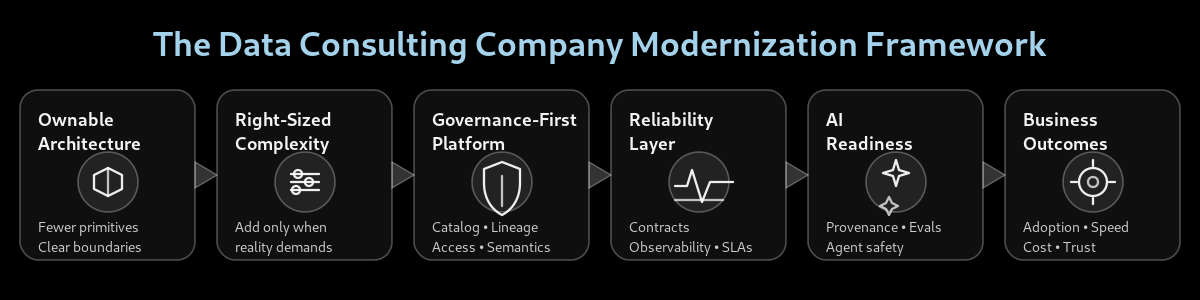
Ownable architecture -> right-sized complexity -> governance first -> reliability layer -> AI readiness -> outcomes
It is not flashy. That is the point.
1. Ownable architecture beats best-of-breed sprawl
Modernization should reduce integration tax, not increase it.
If your platform requires a dozen vendors and three specialists to debug a broken dashboard, you do not have a platform. You have a fragile operating dependency.
Start with durable primitives:
- storage and compute
- orchestration
- catalog and lineage
- observability
- access controls
- standard transformation patterns
Everything else should earn its place.
If the architecture cannot be explained on one whiteboard, it is already a risk.
2. Add complexity only when reality demands it
Many organizations build for future scale that never arrives, then spend years paying for the complexity.
The better pattern is smaller and more honest:
- start with one domain
- create one governed dataset
- connect it to one meaningful outcome
- prove adoption and reliability
- scale the pattern
Streaming, change data capture, multi-region architectures, feature stores, and vector search all have a place. But they are expensive distractions when the business has not proven the need.
Build for the next 12 months, not the next 12 hypotheticals.
3. Use the lightest reliable compute
Not every workload needs a distributed cluster and a sprawling toolchain.
A lot of business analytics is medium data with high expectations. In those cases, local-first engines, embedded analytics, and simpler execution models can remove layers of operational overhead.
The best stack is the one the team does not have to think about every day.
4. Put governance first
Governance is no longer phase two.
It is the enabling layer for secure self-service, consistent metrics, privacy, compliance, and trustworthy AI outputs.
Governance-first means:
- a catalog people actually use
- lineage accurate enough to debug
- access controls that match real roles
- shared definitions for metrics and entities
- policies that show up in systems, not just documents
If nobody can answer “where did this number come from?” the organization is not AI-ready.
5. Make reliability part of the design
Contracts and observability are where modern stacks become useful.
Data contracts turn datasets into products with expectations: schema, definitions, quality rules, freshness, ownership, and allowed usage.
Data observability turns unknown failure into managed risk: freshness, volume, distribution changes, lineage-aware alerts, incident workflows, and measurable reliability.
When those work together, the platform becomes safer to change.
Speed comes from safety.
Safety comes from reliability engineering.
6. Treat AI readiness as an operating discipline
AI readiness is not “we connected a model to the warehouse.”
It means controlled source selection, PII handling, redaction rules, chunking standards, provenance, retrieval evaluation, agent permissions, tool allowlists, audit logs, and human approval where impact is high.
It also means evals.
If you cannot measure output quality, you cannot operate AI in production.
If you cannot test it, you cannot trust it.
If you cannot trust it, do not automate it.
What success looks like
A modern data platform is not defined by tool brands.
It is defined by outcomes:
- business teams use governed data without filing tickets for everything
- new datasets and features ship faster with fewer incidents
- people trust dashboards and AI answers because provenance exists
- cloud spend is visible and intentional
- failures are detected early, triaged quickly, and prevented systematically
Modernization is not about stacking new technologies.
It is about removing friction until the data platform becomes dependable enough to fade into the background.
The best data stack is the one you do not have to keep explaining.